How insulating glass is built and how each choice, from Low-E position to argon and laminated lites, changes U-factor, solar gain, comfort and safety.
Key takeaways
- Low-E coatings and gas fill do more for thermal performance than adding a pane; triple glazing builds on both.
- Triple glazing lowers U-factor and raises interior glass temperature, but adds weight, cost and some loss of light and solar gain.
- Low-E type and position control solar heat gain; choose it by climate and orientation, not by default.
- Tempered glass is about strength and safe breakage; laminated glass is about retention, security, acoustics and impact.
Double glazing with a Low-E coating and argon fill is the baseline for modern windows in most climates; triple glazing adds a third pane and a second cavity, lowering heat loss further and keeping the interior glass warmer, at the cost of weight, price and some daylight. Tempered and laminated glass are separate choices about safety: tempered glass breaks into small fragments, while laminated glass holds together. The right combination depends on climate, orientation, exposure, noise and code requirements.
How is an insulating glass unit built?
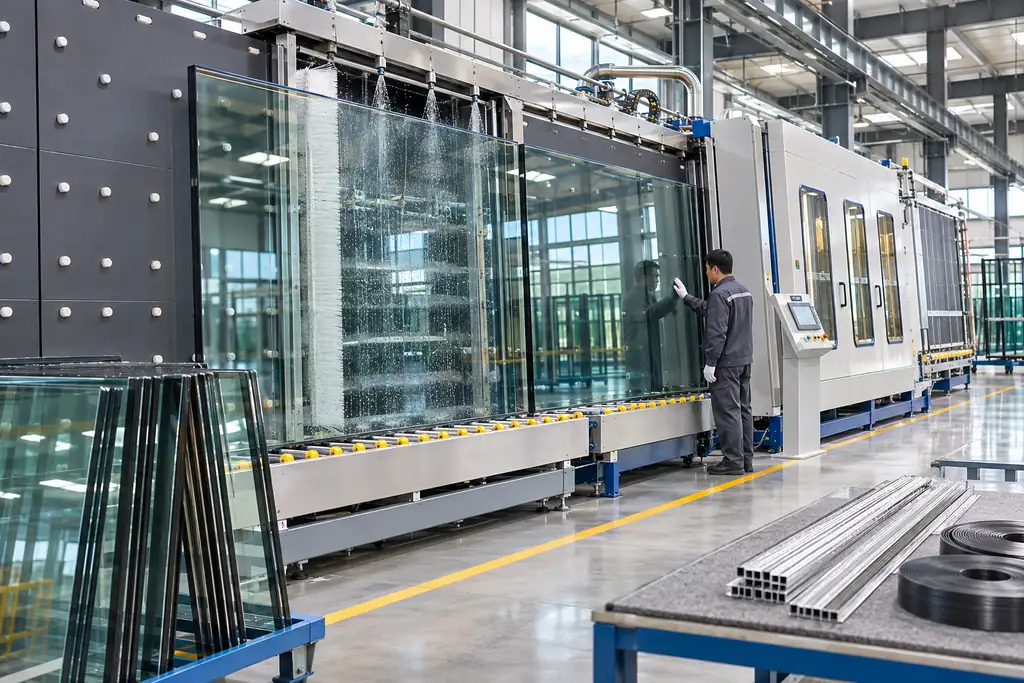
An insulating glass unit (IGU) consists of two or more glass lites separated by a spacer around the perimeter, sealed to keep the cavity dry and gas-tight. The spacer contains desiccant to absorb moisture trapped during manufacture. A primary seal (typically polyisobutylene) limits vapor and gas transmission, and a secondary seal (silicone, polysulfide or polyurethane) provides structural bonding. Unit quality depends on seal application, desiccant capacity and clean manufacturing. Third-party certification of IGUs, such as IGCC certification in North America and SGCC certification for safety glazing, gives independent assurance; many of our window and door series use IGCC/SGCC certified tempered insulating glass.
Glass surfaces are numbered from the outside in: surface 1 is the exterior face, surface 2 the inside face of the outer lite, and so on. Coating positions are described by these numbers.
What does a Low-E coating do?
Low-emissivity (Low-E) coatings are microscopically thin metal or metal-oxide layers that reflect long-wave infrared radiation, the heat radiated by warm room surfaces, while transmitting most visible light. This reduces radiant heat transfer across the cavity and is the single largest improvement to an IGU's U-factor.
- Passive (high solar gain) Low-E admits more solar heat, useful on south-facing glass in cold climates. Typically on surface 3 of a double glazed unit.
- Solar control (low solar gain) Low-E reflects much of the solar infrared, reducing cooling loads in warm climates and on west-facing glass. Typically on surface 2.
- Double and triple silver coatings offer higher selectivity, more light for less solar heat.
Coating choice is a design decision. The same building may benefit from different coatings by orientation, though many projects standardize on one for appearance consistency.
Argon and other gas fills
Replacing the air in the cavity with argon, a denser, less conductive inert gas, reduces conductive and convective heat transfer. Argon is the most common fill because it is inexpensive and effective. Krypton performs better in narrow cavities and is sometimes used in triple glazing where overall thickness is limited, but costs more. Cavity width matters: for argon, there is an optimum width (commonly in the range of roughly 12 to 16 mm) beyond which convection begins to offset the benefit. Many of our window series use a 5 mm + 12 mm argon + 5 mm Low-E tempered make-up, with triple glazing available.
Why do warm-edge spacers matter?
Traditional aluminum spacers conduct heat around the edge of the glass, creating a cold band where condensation forms first. Warm-edge spacers, made from stainless steel, composite or structural foam, reduce this edge loss. The improvement in whole-window U-factor is modest, but the improvement in edge temperature can be significant for condensation control in cold climates.
Double vs triple glazing: how do they compare?
| Factor | Double glazing (Low-E, argon) | Triple glazing (two Low-E, argon) |
|---|---|---|
| Center-of-glass U-value | Typically around 1.0 to 1.1 W/m²·K (about 0.18 to 0.20 Btu) | Typically around 0.5 to 0.7 W/m²·K (about 0.09 to 0.12 Btu) |
| Interior glass temperature in winter | Good | Higher, more comfortable near the glass |
| Condensation resistance | Good | Better |
| Weight | Baseline | Roughly 50% more glass weight |
| Visible light and solar gain | Higher | Somewhat lower |
| Acoustic | Moderate; improves with asymmetric or laminated glass | Similar; asymmetry and lamination matter more than pane count |
| Cost | Baseline | Higher glass and hardware cost |
The figures above are indicative center-of-glass values for common make-ups. Whole-window values will be higher because of the frame and edge, and actual values depend on the specific coating, gas fill and cavity width. Always compare whole-product ratings.
When is triple glazing worth it?
- Cold climates such as Canada, the northern US, northern Europe and alpine New Zealand, where heating dominates and interior comfort near large glass matters.
- Passive House and high-performance projects that set strict whole-window U-values.
- Large glazed areas, where cold glass surfaces cause downdrafts and discomfort.
- Noise, where combined with laminated acoustic glass and asymmetric lite thicknesses.
In mild and hot climates, a well-chosen double glazed unit with solar control Low-E often gives a better balance of cost, weight and performance. Check your energy code requirements, since some jurisdictions in colder zones now drive designers towards triple glazing.
Tempered glass: strength and safe breakage
Tempered (toughened) glass is heated and rapidly cooled, putting the surfaces into compression. It is several times stronger than annealed glass of the same thickness, and when it breaks, it shatters into small, relatively blunt fragments. Building codes require safety glazing in hazardous locations such as doors, glass near doors, low-level glazing and glazing near bathtubs and stairs; tempered glass is the most common way to meet that requirement. Tempered glass cannot be cut after tempering, so sizes must be final before production. Rarely, nickel sulfide inclusions can cause spontaneous breakage; heat soak testing reduces this risk and is often specified for large or overhead glazing.
Laminated glass: retention, security, acoustics and impact
Laminated glass bonds two lites with an interlayer, most commonly PVB, or ionoplast for higher stiffness. When broken, the fragments adhere to the interlayer and the glass remains in the opening. That makes laminated glass the standard choice for:
- Overhead and sloped glazing, where falling glass is a hazard.
- Security, because the interlayer resists penetration.
- Acoustics, especially with acoustic PVB interlayers.
- Hurricane impact, as part of a tested impact assembly.
- UV filtering, since standard interlayers block most UV radiation and reduce fading of interior finishes.
| Property | Annealed | Tempered | Laminated |
|---|---|---|---|
| Relative strength | Baseline | Several times stronger | Depends on lites used |
| Breakage pattern | Large sharp shards | Small fragments | Cracks, held by interlayer |
| Stays in frame after breakage | No | No | Yes |
| Safety glazing | No | Yes | Yes, when it meets safety standards |
| Can be cut after processing | Yes | No | Yes, before tempering components |
How to combine glass types in one unit
An IGU can combine these elements. A common high-performance door make-up uses a tempered outer lite, an argon cavity, and a laminated inner lite with a Low-E coating on the appropriate surface. An impact window might use a heat-strengthened or tempered outer lite and an impact-rated laminated inner lite. For acoustic control, asymmetric lite thicknesses and a laminated acoustic lite are effective. Weight and overall thickness must suit the sash and hardware, particularly in slim-frame systems where glass weight drives roller and hinge selection.
How do glass requirements differ by market?
Exporters and importers should expect different conventions. North American projects are judged on NFRC whole-product U-factor and SHGC, with safety glazing requirements in the building codes and impact requirements in hurricane regions. European projects use Uw and g-values, with CE marking under EN 14351-1. Australia uses AS 1288 for glass selection and AS 2047 for windows, with energy ratings commonly expressed through WERS; New Zealand uses NZS 4223 for glazing and has tightened H1 energy requirements in recent years, making double glazing with Low-E standard and pushing many projects towards higher-performance frames and glass. Specify glass to the market's standards and labeling, and confirm with local code or a certifier when in doubt.
A glass specification checklist
- Define thermal targets: whole-product U-factor and SHGC, or Uw and g-value, by climate and code.
- Choose Low-E type by orientation and climate; confirm visible transmittance for daylight.
- Select double or triple glazing based on climate, comfort and project goals.
- Identify safety glazing locations; specify tempered or laminated as required by code.
- Add laminated lites for security, acoustics, impact or overhead locations.
- Specify warm-edge spacers and certified IGU fabrication.
Our aluminum windows are available in double and triple glazed configurations. To see how these values appear on certification labels, read how to read NFRC labels.
Frequently asked questions
Is triple glazing worth it compared with double glazing?
In cold climates, Passive House projects and rooms with large glass areas, often yes: it lowers heat loss and keeps interior glass warmer. In mild or hot climates, a good double glazed unit with the right Low-E coating usually offers better value. Check energy code targets and frame capacity.
What is the difference between tempered and laminated glass?
Tempered glass is heat-treated to be several times stronger than annealed glass and breaks into small fragments. Laminated glass bonds lites with an interlayer so broken glass stays in place. Tempered suits safety glazing; laminated adds retention, security, acoustics, UV filtering and impact performance.
Does argon gas leak out of windows over time?
Well-made, properly sealed insulating glass units retain argon for many years, with slow gradual loss. Seal quality, manufacturing control and certification matter. Certified IGU fabrication and a good primary seal limit loss, so the thermal benefit remains for most of the unit's service life.
Which side should the Low-E coating be on?
It depends on the goal. For solar control in warm climates, the coating is typically on surface 2, the inner face of the outer pane. For passive solar gain in cold climates, it is often on surface 3. Triple glazed units commonly use two coatings, on surfaces 2 and 5.
Related products